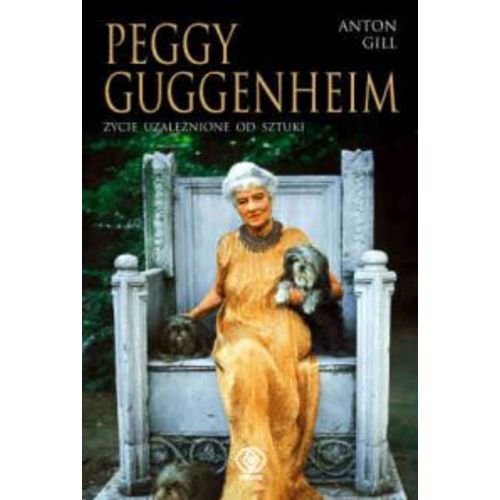
Marguerite "Peggy" Guggenheim (August 26, 1898 – December 23, 1979) was an American art collector. Born to a wealthy New York City family, she was the daughter of Benjamin Guggenheim, who went down with the Titanic in 1912 and the niece of Solomon R. Guggenheim, who would establish the Solomon R. Guggenheim Foundation. Peggy's father was of Swiss-German Jewish origin, and her mother Jewish, German, and Dutch.
At the age of 21, Peggy Guggenheim inherited a small fortune of 2.5 million dollars. This would be roughly 20 million in today's money. Guggenheim's father, Benjamin Guggenheim died in the sinking of the RMS Titanic and he had not amassed the fortune of his siblings, therefore her inheritance was far less than the vast wealth of her cousins.
She was a clerk in an avant-garde bookstore when she first became enamored with the members of the bohemian artistic community. In 1920 she went to live in Paris, France. Once there, she became friendly with avant-garde writers and artists, many of whom were living in poverty in the Montparnasse quarter of the city. Man Ray photographed her, and was, along with Constantin Brancusi and Marcel Duchamp, a friend whose art she promoted.
She became close friends with writer Natalie Barney and artist Romaine Brooks, and was a regular at Barney's stylish salon. She met Djuna Barnes during this time, and in time became her friend and patron. Barnes wrote her best-known novel, Nightwood, while staying at the Devonshire country manor, 'Hayford Hall', that Guggenheim had rented for two summers.
In 1938, she opened a gallery for modern art in London featuring Jean Cocteau and began to collect works of art. After the outbreak of World War II, she purchased as much abstract and Surrealist art as possible.
Peggy Guggenheim opened the gallery Guggenheim Jeune in London in January 1938 — the name being quite ingeniously chosen to associate the epitome of a gallery, the French Bernheim Jeune, with the name of her own well known family. The gallery on 30 Cork Street, next to Roland Penrose's and E. L. T. Mesens' show-case for the Surrealist movement, the London Gallery, proved to be quite successful, thanks to many friends who gave advice and who helped run the gallery. Marcel Duchamp, whom she had known since the early 1920s, when she lived in Paris with her first husband Laurence Vail, was taken on to introduce Peggy Guggenheim to the art world; it was through him that she met many artists during her frequent visits to Paris. He taught her about contemporary art and styles, and he conceived several of the exhibitions held at Guggenheim Jeune.
The gallery's opening show was dedicated to Jean Cocteau. It was followed by exhibitions on Wassily Kandinsky (his first one-man-show in England), Yves Tanguy, Wolfgang Paalen and several other well known and some lesser-known artists. Peggy Guggenheim also held group exhibitions of sculpture and collage, with the participation of the now classic moderns Antoine Pevsner, Henry Moore, Henri Laurens, Alexander Calder, Raymond Duchamp-Villon, Constantin Brancusi, Jean Arp, Max Ernst, Pablo Picasso, George Braque and Kurt Schwitters. She also greatly admired the work of John Tunnard (1900–1971) and is credited with his discovery in mainstream international modernism.
Plans for a museum:
When Peggy Guggenheim realised that her gallery, although well received, had made an actual loss of £600 in the first year, she decided to take up this idea and spend the money in a much more practical way. A museum for contemporary arts was exactly the institution she could see herself supporting. Most certainly on her mind were also the adventures of her uncle, Solomon R. Guggenheim in New York, who, with the help and encouragement of Hilla Rebay, had created the Solomon R Guggenheim Foundation two years earlier. The main aim of this foundation had been to collect and to further the production of abstract art, resulting in the opening of the Museum of Non-objective Painting (from 1952: The Solomon R Guggenheim Museum) earlier in 1939 on East 54th Street in Manhattan. Peggy Guggenheim closed Guggenheim Jeune with a farewell party on 22 June 1939, at which colour portrait photographs by Gisèle Freund were projected on the walls. She started making plans for a Museum of Modern Art in London together with the English art historian and art critic Herbert Read. She set aside $40,000 for the museum's running costs. However, these funds were soon overstretched with the organisers' ambitions.
In August 1939, Peggy Guggenheim left for Paris to negotiate loans for the first exhibition. In her luggage was a list drawn up by Herbert Read for this occasion. Shortly after her departure the Second World War broke out, and the events following 1 September 1939 made her abandon the scheme, willingly or not.
She then "decided now to buy paintings by all the painters who were on Herbert Read's list. Having plenty of time and all the museum's funds at my disposal, I put myself on a regime to buy one picture a day."[1] When finished, she had acquired ten Picassos, forty Ernsts, eight Mirós, four Magrittes, three Man Rays, three Dalís, one Klee, one Wolfgang Paalen and one Chagall among others. In the meantime, she had also made new plans and in April 1940 had rented a large space in the Place Vendôme as a new home for her museum.
A few days before the Germans reached Paris, Peggy Guggenheim had to abandon her plans for a Paris museum, and fled to the south of France, from where, after months of safeguarding her collection and artist friends, she left Europe for New York in the summer of 1941. There, in the following year, she opened a new gallery which actually was in part a museum. It was called The Art of This Century Gallery. Three of the four galleries were dedicated to Cubism, Surrealism and Kinetic art, with only the fourth, the front room, being a commercial gallery.
As a result of her interest in new artists she was instrumental in advancing the careers of many important modern artists, including the American painter Jackson Pollock and William Congdon, the Austrian surrealist Wolfgang Paalen, the sound poet Ada Verdun Howell and the German painter Max Ernst, whom she married in December 1941.Following World War II — and her 1946 divorce from Max Ernst — she closed The Art of This Century Gallery in 1947, and returned to Europe; deciding to live in Venice, Italy. In 1948, she was invited to exhibit her collection in the disused Greek Pavilion of the Venice Biennale and eventually established herself in the Palazzo Venier dei Leoni on the Grand Canal.
Her collection became one of the few European collections of modern art to promote a significant amount of works by Americans.
By the early 1960s, Peggy Guggenheim had stopped collecting art and began to concentrate on presenting what she already owned. She loaned out her collection to museums throughout Europe and America, including the Solomon R. Guggenheim Museum in New York City, which was named after her uncle. Eventually, she decided to donate her large home and her collection to the Solomon R. Guggenheim Foundation on her death.
The Peggy Guggenheim Collection is one of the most important museums in Italy for European and American art of the first half of the 20th century. Pieces in her collection embrace Cubism, Surrealism and Abstract Expressionism.
Peggy Guggenheim lived in Venice until her death in Padua, Italy after a stroke. She is interred in the garden of her home, the Palazzo Venier dei Leoni, next to her beloved dogs.rting in late December 1937, she and Samuel Beckett had a brief affair.
Peggy Guggenheim's first marriage was to Laurence Vail, a Dada sculptor and writer with whom she had two children, Michael Sindbad and Pegeen Vail Guggenheim. They divorced following his affair with writer Kay Boyle, whom he later married. She married her second husband, Max Ernst, in 1941 and divorced him in 1946.
In her autobiography, she claims to have had affairs with numerous artists and in return many others, including artists, have claimed affairs with her. She is even mentioned as having had affairs with fictional characters, for example William Boyd's Nat Tate.
One affair that occurred with little knowledge was that between Guggenheim and her next door neighbour in Venice, the late manager of The Who rock band Christopher 'Kit' Lambert. Peggy had known Lambert's father Constant Lambert, the classical composer and a close friend of Cocteau. Kit Lambert later recalled he had been fascinated by Guggenheim. He purposely purchased a villa next to Guggenheim's on the Grand Canal. For a while the two became close friends and then lovers over a period of six months. Guggenheim finally ended the affair with the parting words to Lambert which he often repeated. His heroin and drug consumption horrified Peggy and she confronted Lambert one morning to tell him their affair was over. "Quite simply", said Peggy, "I just cannot afford you !".
She has eight grandchildren: Clovis, Mark, Karole and Julia Vail, from her son, and Fabrice, David and Nicolas Hélion and Sandro Rumney from her daughter. She also has seven great nieces and nephews: Gabrielle, Chantal, Maya, Daniel, Michael, and John.
Peggy Guggenheim is portrayed by Amy Madigan in the movie Pollock (2000), directed by Ed Harris, based on the life of Jackson Pollock.
A play by Lanie Robertson based on Peggy Guggenheim's life, Woman Before a Glass, opened at the Promenade Theatre on Broadway, New York on March 10, 2005. It is a one woman show, which focuses on Peggy Guggenheim's later life. Mercedes Ruehl plays Peggy Guggenheim. Ruehl received an Obie award for her performance.
In Bethan Roberts' first play for radio, "My Own Private Gondolier", Peggy Guggenheim's troubled daughter, Pegeen, leaves her three children behind when she travels to Venice to spend the summer with her mother. Pegeen is in retreat from a marriage that has failed. She is determined to be an artist, and she shuts herself up in the dank basement, trying to paint. Meanwhile, her mother, Peggy, is much more concerned with the English sculptor who has come to visit; she wants a piece of his work to add to her collection and will use everything at her disposal to achieve her aim. She'll even try to inveigle her daughter into the plan if she thinks it will get her what she wants. Peggy is well known as a collector of men, as well as art. As the summer progresses, and the strains between mother and daughter grow, it's only Gianni, Peggy's personal Gondolier, who can provide a welcome diversion. The play was first broadcast on BBC Radio 4 on Oct. 19, 2010. Peggy Guggenheim was played by Fiona Shaw.
This site is about things I find interesting or feel you should know about--Fashion, men, news, politics, gay awareness issues and above all it's definitely GAY! I am a Kent State University English Major,striving to be a writer, and I am a 40-something Gay man so this should be a really fun visit... grab your favorite cocktail and enjoy reading.
According to Examiner.com
According to the Examiner.com---since 01/09/11
Showing posts with label Socialite. Show all posts
Tuesday, January 25, 2011
Friday, January 7, 2011
Franciso Costa--- Who's Who in Fashion
Francisco Costa was born May 10, 1961 is the creative director of Calvin Klein Collection. Costa won the Council of Fashion Designers America (CFDA) award for best womenswear designer in March 2006 as well as in June 2008. Costa also won the National Design Award in 2009 in the category of Fashion Design. Costa's designs have sometimes estranged longtime Calvin Klein customers. His clothes are lighter and more feminine than those marketed by Calvin Klein previously.
Costa is the second youngest of five children. He grew up in Guarani, Brazil, where his mother, Maria-Francisca, owned a children's wear factory. She began her business producing dresses commissioned by a traveling salesman. Costa's father, Jacy Neves da Costa, ran a small ranch. In his hometown of 8,000 people, Costa put on fashion shows for charities. His size is compact and he has brown eyes. Being civic minded by nature, his mother was like the mayor of the town. She presided over her family. Costa remembers there being fifteen people at his family's lunch table.
When his mother died in 1981 he left with a friend for New York City. He was twenty and spoke no English at the time. He enrolled in a language class at Hunter College and took courses at the Fashion Institute of Technology at night. He obtained employment with Herbert Rounick, whose Seventh Avenue (Manhattan) company made dresses for Oscar de la Renta and Bill Blass. Costa went to work for de la Renta after Rounick's death, designing for the firm's Japanese licenses. Costa credits de la Renta with teaching him the most about both designing clothes and life. He remained with the company for five years.
Klein's partner, Barry Schwartz, brought Costa's name to Klein's attention in 2001. Costa became the principal designer for Calvin Klein at the age of 42, in September 2003. Earlier in the year Klein sold his company to Phillips-Van Heusen for approximately $730 million. Co sta joined the Klein design group in 2001 after working for Gucci, where he was an assistant to Tom Ford. Their first collaboration is known as the Cher Collection. Costa was mentioned as a possible replacement when Ford retired from designing for Gucci and Yves Saint Laurent, in late 2003.
He emphasized trouser suits for women as opposed to ruffles in the spring 2004 collections. His creations stress the idea of freedom in dress with female underpinnings. With evening dresses Costa's designs reveal both flesh and underpants, often accentuated by the cool hues of the sea. He is not uptight concerning nudity and lingerie. Costa prefers sensuality in sexual imagery as opposed to the more explicit ads used to market Calvin Klein clothes formerly.
For 2004 his models wore stretch bras and underpants in foundation colors. Costa utilized a clingy, transparent material for daytime skirts. He combined them with cashmere tops, which sometimes gave the look an artificial quality. Costa's loose cotton shorts, modelled with cardigan sweaters, were layered over rumpled white shirts and men's ribbed undershirts. This look reflected the late 1970s styles when designers like Calvin Klein and Perry Ellis came to prominence.
Costa maintains a ledger-size mood book in his studio. In early 2004 photographs of horses by Max Eastman appeared frequently in these volumes. Costa is inspired by the coats of horses, especially in his palettes of sepia and cream. The textures of his collection owe much to pony skin, alpaca, and leather. He enjoys photographs of Lauren Hutton and Charlotte Rampling from the 1970s, particularly ones which have them posed in close proximity with ponies and stallions. Costa said, These women are thoroughbreds.
In the fall of 2004 Costa introduced washed silk dresses and black wool felt coats. The clothing was given weight by the librarian brogue heel, variations of which first appeared at Calvin Klein. The style was exceedingly popular during both the Paris, France and Milan, Italy shows.
In his collection for Spring 2005 Costa showed a sea-green silk dress wrapped like a towel. An alternative of the dress, of like color and style, was unveiled on the runway in September 2004. The silk dress was coveted by many buyers and was shipped to stores in the late fall and early winter.
The original inspiration for this collection were primitive wood sculptures by Brancusi. After spending a week in Wyoming Costa aspired to capture the surreal hues of green, blue, and orange, which he had observed juxtaposed with the western landscape at Yellowstone National Park. Costa purchased silk and viscose jersey (clothing) in the garment center of New York City. He had these dyed to match the colors he had photographed in Wyoming. Next he pinned the fabrics on a model, blending and shaping the patterns until he was pleased with their natural effect. The evening dresses he designed were uncomplicated. They were based on a trapeze, combining viscose jersey with silk to make them appear lively.
Vogue and Harper's Bazaar chose a lime green dress worn by Elle Macpherson as a highlight of 2005. Both publications named her to their best dressed lists after she wore the Costa design, which she combined with casual flats. Macpherson asked Costa to pick the color and he selected lime green. It was especially attractive on her because of her skin color.
Costa's new collection for Calvin Klein was criticized by critic, Cathy Horyn, for conveying largely a surface beauty. She wrote about his February 2006 showing in the New York Times. It featured dresses with many layers of black chiffon and tulle. Horn pointed out that Calvin Klein is a sportswear house, not a dress house, and Costa is gifted with a talent for designing sportswear. His collection was reminiscent of the 1930s, with shapes which were long and relaxed. The models wore chiffon bras with tiny handkerchief points of chiffon on their dresses, which extended nakedly across their backs. Horn wondered if many women would not find the fashions untenable and fussy, if not stifling."
In May 2006 Costa served as chairman of a benefit for the Whitney Museum of American Art. He conceived a project for the museum which created art out of fashion. He approached artists Ghada Amer, Vik Muniz, and Billy Sullivan about making art which would be clearly identified with fashion. After showing at the Whitney Art Party, the work was moved and displayed in the windows of the Calvin Klein boutique on Madison Avenue, Manhattan.
Costa designed a line of long slim dresses and pantsuits which were introduced in September 2007. They were constructed of white stretch cotton. His collection featured long stretch silk T-shirts in egg-wash shades of green or blue. The colors accentuated the refreshing impression of the lines, especially Costa's spare evening halters worn with high-waist silk trousers and a strapless dress of pale jade organza. Reviewer Horyn had only one criticism of a collection she believes will gain more meaning with time. This was Costa's failure to notice that the hemlines of his dresses should have been longer.
As of May 2004 Costa's partner was horse trainer John DeStefano Jr. The two had been together fourteen years. Costa donned a coat and tie to join DeStefano for opening day at Belmont Park, where the latter had horses running in the eighth and ninth races. Costa and DeStefano met at George Smith, the furniture store where Costa worked on Saturdays to supplement the salary he earned on Seventh Avenue.
Costa is the second youngest of five children. He grew up in Guarani, Brazil, where his mother, Maria-Francisca, owned a children's wear factory. She began her business producing dresses commissioned by a traveling salesman. Costa's father, Jacy Neves da Costa, ran a small ranch. In his hometown of 8,000 people, Costa put on fashion shows for charities. His size is compact and he has brown eyes. Being civic minded by nature, his mother was like the mayor of the town. She presided over her family. Costa remembers there being fifteen people at his family's lunch table.
When his mother died in 1981 he left with a friend for New York City. He was twenty and spoke no English at the time. He enrolled in a language class at Hunter College and took courses at the Fashion Institute of Technology at night. He obtained employment with Herbert Rounick, whose Seventh Avenue (Manhattan) company made dresses for Oscar de la Renta and Bill Blass. Costa went to work for de la Renta after Rounick's death, designing for the firm's Japanese licenses. Costa credits de la Renta with teaching him the most about both designing clothes and life. He remained with the company for five years.
Klein's partner, Barry Schwartz, brought Costa's name to Klein's attention in 2001. Costa became the principal designer for Calvin Klein at the age of 42, in September 2003. Earlier in the year Klein sold his company to Phillips-Van Heusen for approximately $730 million. Co sta joined the Klein design group in 2001 after working for Gucci, where he was an assistant to Tom Ford. Their first collaboration is known as the Cher Collection. Costa was mentioned as a possible replacement when Ford retired from designing for Gucci and Yves Saint Laurent, in late 2003.
He emphasized trouser suits for women as opposed to ruffles in the spring 2004 collections. His creations stress the idea of freedom in dress with female underpinnings. With evening dresses Costa's designs reveal both flesh and underpants, often accentuated by the cool hues of the sea. He is not uptight concerning nudity and lingerie. Costa prefers sensuality in sexual imagery as opposed to the more explicit ads used to market Calvin Klein clothes formerly.
For 2004 his models wore stretch bras and underpants in foundation colors. Costa utilized a clingy, transparent material for daytime skirts. He combined them with cashmere tops, which sometimes gave the look an artificial quality. Costa's loose cotton shorts, modelled with cardigan sweaters, were layered over rumpled white shirts and men's ribbed undershirts. This look reflected the late 1970s styles when designers like Calvin Klein and Perry Ellis came to prominence.
Costa maintains a ledger-size mood book in his studio. In early 2004 photographs of horses by Max Eastman appeared frequently in these volumes. Costa is inspired by the coats of horses, especially in his palettes of sepia and cream. The textures of his collection owe much to pony skin, alpaca, and leather. He enjoys photographs of Lauren Hutton and Charlotte Rampling from the 1970s, particularly ones which have them posed in close proximity with ponies and stallions. Costa said, These women are thoroughbreds.
In the fall of 2004 Costa introduced washed silk dresses and black wool felt coats. The clothing was given weight by the librarian brogue heel, variations of which first appeared at Calvin Klein. The style was exceedingly popular during both the Paris, France and Milan, Italy shows.
In his collection for Spring 2005 Costa showed a sea-green silk dress wrapped like a towel. An alternative of the dress, of like color and style, was unveiled on the runway in September 2004. The silk dress was coveted by many buyers and was shipped to stores in the late fall and early winter.
The original inspiration for this collection were primitive wood sculptures by Brancusi. After spending a week in Wyoming Costa aspired to capture the surreal hues of green, blue, and orange, which he had observed juxtaposed with the western landscape at Yellowstone National Park. Costa purchased silk and viscose jersey (clothing) in the garment center of New York City. He had these dyed to match the colors he had photographed in Wyoming. Next he pinned the fabrics on a model, blending and shaping the patterns until he was pleased with their natural effect. The evening dresses he designed were uncomplicated. They were based on a trapeze, combining viscose jersey with silk to make them appear lively.
Vogue and Harper's Bazaar chose a lime green dress worn by Elle Macpherson as a highlight of 2005. Both publications named her to their best dressed lists after she wore the Costa design, which she combined with casual flats. Macpherson asked Costa to pick the color and he selected lime green. It was especially attractive on her because of her skin color.
Costa's new collection for Calvin Klein was criticized by critic, Cathy Horyn, for conveying largely a surface beauty. She wrote about his February 2006 showing in the New York Times. It featured dresses with many layers of black chiffon and tulle. Horn pointed out that Calvin Klein is a sportswear house, not a dress house, and Costa is gifted with a talent for designing sportswear. His collection was reminiscent of the 1930s, with shapes which were long and relaxed. The models wore chiffon bras with tiny handkerchief points of chiffon on their dresses, which extended nakedly across their backs. Horn wondered if many women would not find the fashions untenable and fussy, if not stifling."
In May 2006 Costa served as chairman of a benefit for the Whitney Museum of American Art. He conceived a project for the museum which created art out of fashion. He approached artists Ghada Amer, Vik Muniz, and Billy Sullivan about making art which would be clearly identified with fashion. After showing at the Whitney Art Party, the work was moved and displayed in the windows of the Calvin Klein boutique on Madison Avenue, Manhattan.
Costa designed a line of long slim dresses and pantsuits which were introduced in September 2007. They were constructed of white stretch cotton. His collection featured long stretch silk T-shirts in egg-wash shades of green or blue. The colors accentuated the refreshing impression of the lines, especially Costa's spare evening halters worn with high-waist silk trousers and a strapless dress of pale jade organza. Reviewer Horyn had only one criticism of a collection she believes will gain more meaning with time. This was Costa's failure to notice that the hemlines of his dresses should have been longer.
As of May 2004 Costa's partner was horse trainer John DeStefano Jr. The two had been together fourteen years. Costa donned a coat and tie to join DeStefano for opening day at Belmont Park, where the latter had horses running in the eighth and ninth races. Costa and DeStefano met at George Smith, the furniture store where Costa worked on Saturdays to supplement the salary he earned on Seventh Avenue.
Thursday, December 30, 2010
The start of a new weekly feature--30 fashionable people
A few days ago I finished reading "The Little Black Book of Style" by Nina Garcia--which by the way is a MUST read--- and in that book I ran across a bunch of names I did not recoginize. Thirty names to be exact. So I compiled a list of those names. I then decided I would research and write about all thirty of those names over the next year in this blog. One name a week over the next thirty weeks. Because if I don't know then you may not know them as well. We will learn together.
So the first name, and in no particular order is-----Nan Kempner born July 24, 1930 and died July 3, 2005. She was a New York City socialite, famous for dominating society events, shopping, charity work and of course fashion.
She was born as Nan Field Schlesinger in San Francisco, an only child from a wealthy family. Her father, Albert "Speed" Schlesinger, owned the largest car dealership in California and reportedly told his daughter "You'll never make it on your face, so you'd better be interesting."
She attended Connecticut College and met Thomas Lenox Kempner, a banker. In the early 1950s they married and had three children. After living in London for a short time the Kempners moved to New York City, where Nan took the initiative to become a leader in society.
Over a thirty year period she helped raise over $75,000,000 (USD) for the Memorial Sloan-Kettering Cancer Center. She also amassed the largest private collection of haute couture clothing featuring classic designers like Mainbocher and her favorite designers Yves Saint Laurent and Bill Blass.
At various times in her life Kempner worked as a contributing editor for French Vogue, a fashion editor for Harper's Bazaar, a design consultant for Tiffany & Co. and an international representative of the auction house Christie's.
In Armistead Maupin's "Tales of the City" series, two society matrons discuss the creation of a society wax museum, emphasizing that future generations might not otherwise know what Nan Kempner looked like. Kempner herself authored a book about how to be a truly great host entitled R.S.V.P. (2000, ISBN 0-609-60430-9). The proceeds of the book benefited several charities.
Diana Vreeland, former editor of Vogue, once said: "There are no chic women in America. The one exception is Nan Kempner."
Notable quotes said by Nan Kempner:
I wouldn't miss the opening of a door.
Some people say the camera loves me, the truth is, I love the camera.
The only plastic I want is plastic surgery!
I want to be buried naked, I know there's a store where I'm going.
I spend way more than I should ... and way less than I want.
So the first name, and in no particular order is-----Nan Kempner born July 24, 1930 and died July 3, 2005. She was a New York City socialite, famous for dominating society events, shopping, charity work and of course fashion.
She was born as Nan Field Schlesinger in San Francisco, an only child from a wealthy family. Her father, Albert "Speed" Schlesinger, owned the largest car dealership in California and reportedly told his daughter "You'll never make it on your face, so you'd better be interesting."
She attended Connecticut College and met Thomas Lenox Kempner, a banker. In the early 1950s they married and had three children. After living in London for a short time the Kempners moved to New York City, where Nan took the initiative to become a leader in society.
Over a thirty year period she helped raise over $75,000,000 (USD) for the Memorial Sloan-Kettering Cancer Center. She also amassed the largest private collection of haute couture clothing featuring classic designers like Mainbocher and her favorite designers Yves Saint Laurent and Bill Blass.
At various times in her life Kempner worked as a contributing editor for French Vogue, a fashion editor for Harper's Bazaar, a design consultant for Tiffany & Co. and an international representative of the auction house Christie's.
In Armistead Maupin's "Tales of the City" series, two society matrons discuss the creation of a society wax museum, emphasizing that future generations might not otherwise know what Nan Kempner looked like. Kempner herself authored a book about how to be a truly great host entitled R.S.V.P. (2000, ISBN 0-609-60430-9). The proceeds of the book benefited several charities.
Diana Vreeland, former editor of Vogue, once said: "There are no chic women in America. The one exception is Nan Kempner."
Notable quotes said by Nan Kempner:
I wouldn't miss the opening of a door.
Some people say the camera loves me, the truth is, I love the camera.
The only plastic I want is plastic surgery!
I want to be buried naked, I know there's a store where I'm going.
I spend way more than I should ... and way less than I want.
Subscribe to:
Posts (Atom)